
Before religions were brought to Kenya, most communities believed in a single deity within their tribe who was merciful and peaceful and seen as a Father.
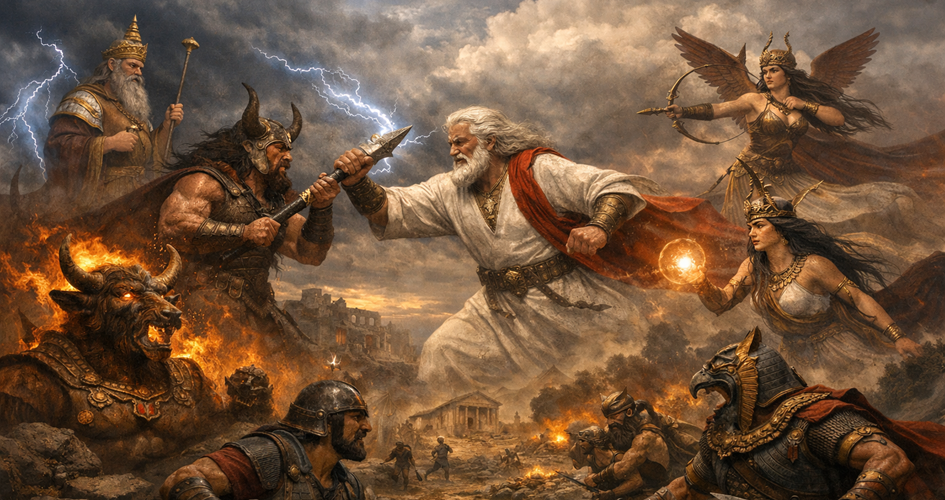
Like the different cultures that existed in the semitic world where the bible is based, there existed different Gods.
Bible itself shows that the ancient world had many different gods being worshipped, inasmuch as Israel was commanded to worship only one after a successful battle with the various gods.
Early Israelites worshipped Yahweh alongside other deities like El, Baal, Chemosh, Molech, and Asherah.
Yahweh was initially a regional storm and war god, and his worship was gained by political dominance and cultural suppression.
Verses Showing Yahweh as Storm-War God
- Jeremiah 23:19 ; “Behold, the storm of Yahweh has gone forth in wrath, even a whirling storm; it shall burst on the head of the wicked.”
- Jeremiah 30:23 ; “Behold, the storm of the LORD has gone out with fury, a whirlwind swirling down upon the heads of the wicked.”
25 Verses That Prove Existence of Other Gods
1. Exodus 20:3
“You shall have no other gods before Me.” , this is the clearest admission that other gods existed.
2. Exodus 18:11
“Now I know that the Lord is greater than all other gods.” … Ask yourself who “all other gods” were
3. Exodus 23:13
“Do not invoke the names of other gods; do not let them be heard on your lips.”
4. Exodus 23:24
“Do not bow down before their gods or worship them.”
5. Exodus 34:14
“Do not worship any other god, for the Lord… is a jealous God.”
6. Deuteronomy 6:14
“Do not follow other gods, the gods of the peoples around you.”
7. Deuteronomy 11:16
“Take heed… that you turn aside and serve other gods and worship them.”
8. Deuteronomy 13:2
“…Let us go after other gods, which you have not known.”
9. Deuteronomy 17:3
“Has gone and served other gods and worshiped them…”
10. Deuteronomy 32:17
“They sacrificed to demons, not God, to gods they had not known.”
11. Joshua 24:2
“…Your fathers served other gods beyond the River.”
12. Joshua 24:14–15
“Put away the gods your ancestors worshiped…”
13. Judges 2:12
“They followed other gods, from among the gods of the peoples around them.”
14. Judges 10:6
“They served the Baals and the Ashtoreths and the gods of Aram…” btw… Aram is the current Syria.
15. 1 Kings 11:4
“His wives… turned his heart after other gods.”
16. 1 Kings 11:10
“…that he should not go after other gods, but he did not keep what the Lord commanded.”
17. 2 Kings 17:7
“…they had worshiped other gods.”
18. Psalm 82:1
“God stands in the divine assembly; He judges among the gods.”
This one is very interesting, it treats “gods” as real spiritual beings.
19. Psalm 86:8
“Among the gods there is none like You, O Lord.”
20. Jeremiah 25:6
“Do not go after other gods to serve and worship them.”
21. Jeremiah 7:18
“…they provoke Me to anger with the works of their hands, following other gods.”
22. Daniel 11:38
“But instead he will honor a god of fortresses… a god his fathers did not know.”
23. Hosea 3:1
“…they turn to other gods and love flagons of wine.”
24. Jonah 2:8
“Those who cling to worthless idols forsake the mercy that could be theirs.”
25. Zephaniah 1:5
“…those who bow down and swear by the Lord and also swear by Milcom.”
Unlike worshipers today, the Bible itself, never denies that other gods existed in the ancient worldview it only says:
- Israel must not worship them
- Yahweh is above all of them
- some are idols, some are “demons,” some are spiritual beings
In other words, the Bible comes from a polytheistic world that slowly became monotheistic over time through conquest.
How Yahweh Became The Center of Jewish, Christian, and Islamic Traditions.
The Hebrew Bible canonized Yahweh as the only true God, embedding monotheism into Israelite law, worship, and daily life, as other deities and traditions were suppressed or erased, and many local gods became demonized or forgotten, narrowing spiritual diversity.
Like in Kenya, the Agikuyu had Ngai, others had Enkai and others Nyasaye, who have been replaced by Yahweah since the arrival of the missionaries..
In Judaism;
Yahweh worship became the foundation of Jewish identity.
In Christianity;
They reinterpreted Yahweh as the Father, with Jesus as divine Son, expanding worship globally.
In Islam
They Adopted the same God (Allah), tracing back to Yahweh’s monotheistic tradition.
Together, these Abrahamic faiths spread Yahweh’s worship across continents – even using violence – making him the most widely recognized deity in history.
This win was as a result of political crises, colonisation and the global spread of Abrahamic religions.
In Kenya:
In Kenyan context, The British colonial government aligned with missionary efforts of building schools and hospitals tied in the Christian teachings which gave “Yahweh” worship institutional power. Which made this new god seem more powerful compared to the community tribal gods.
For instance;
In his memoirs John Boyes: King of the Wa-Kikuyu, published in 1911, he describes how he impressed and tricked the Kikuyu by using his rifle to shoot a distant shield. He claimed this demonstrated that his God was more powerful than theirs, because the weapon seemed like divine power to people who had never seen firearms before.
How Our Cultures Slowly Adapted To The New God
- By translating the Bible into Kikuyu, Kiswahili, and other languages made Yahweh worship accessible.
- Christians then reinterpreted Yahweh as a liberator, aligning biblical stories of Exodus with anti-colonial struggle.
- By Syncretism, by communities blending Yahweh worship with traditional practices e.g., prayers to Ngai reinterpreted as prayers to Yahweh.
- By Merging existing Practices, African Independent Churches emerged, and mixed Yahweh worship with African cultural expressions, songs, dances, and rituals.
- Via Education & Literacy, Mission schools taught reading through the Bible, linking Yahweh worship to “modernity” and “opportunity”.
- Via coersion and rewarding those who sold out mau mau and their hideouts.
Yahweh worship in Kenya is the result of missionary introduction, colonial reinforcement, cultural adaptation, and post-independence revival movements, and Not because the existing tribal deities in the different tribes were illegitimate or powerless.
It was largely the result of political influence, cultural consolidation, and theological reinterpretation.