Unfortunately, the Kenyan education system is yet to decolonize despite the overflow of information today. Such that, most Kenyans learnt about the existence of a Strait because of the ongoing Iran-USA war.
It’s infuriating to learn that we actually finished high school without learning anything about any strait, but the system was so good at teaching us about Moses and the Red Sea.
Luckily, today, we have the freedom and affordable internet to research and learn all about it ourselves. So lets go!
So, what is a STRAIT?
A strait is a naturally formed narrow waterway connecting two larger bodies of water and lying between two landmasses.
Straits are found between continents, countries, and along busy trade routes.
There are many straits, but geopolitical and trade discussions focus on a subset of about two dozen important ones.
The Major Straits Are:
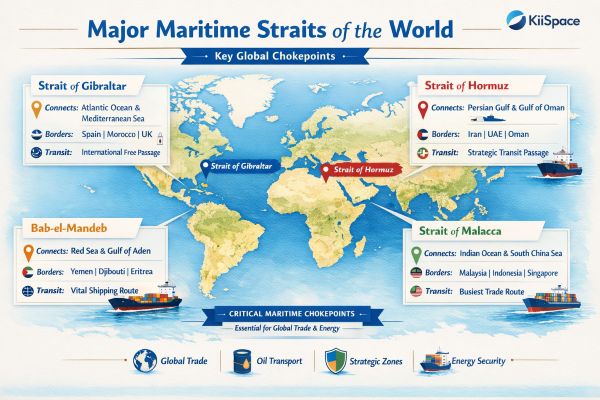
1. Strait of Gibraltar
This one is between Spain and Morocco, connecting the Atlantic Ocean and the Mediterranean Sea.
2. Strait of Malacca
This one is between Indonesia and Malaysia, linking the Andaman Sea – Indian Ocean – with the South China Sea – Pacific
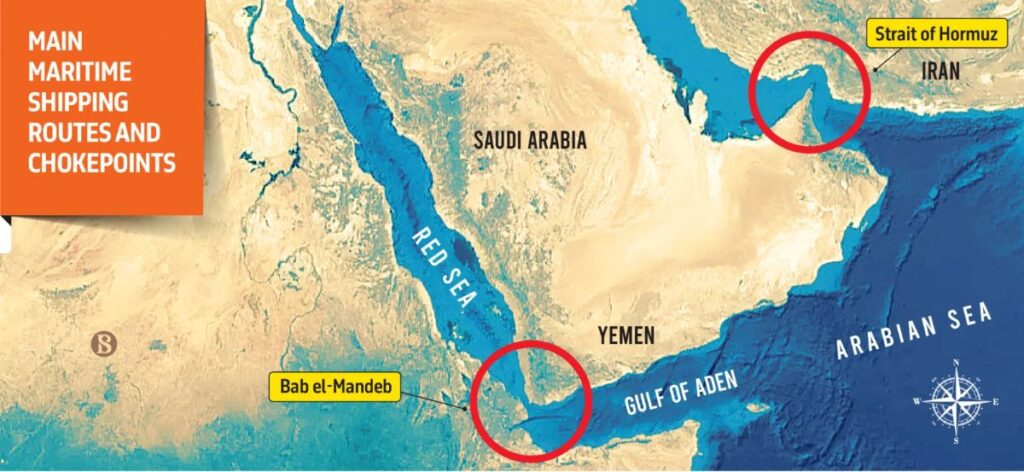
3. Strait of Hormuz
This one is between Iran and Oman. It connects the Persian Gulf with the Gulf of Oman – Arabian Sea/Indian Ocean.
4. Strait of Bab‑el‑Mandeb
This one is between Yemen, Djibouti, and Eritrea. It links the Red Sea to the Gulf of Aden and the Indian Ocean.
5. Strait of Magellan
This one is along the southern tip of South America – Chile; connecting the Atlantic and Pacific Oceans.
6. Bering Strait
This one is between Russia and Alaska – USA. It separates the Bering Sea from the Chukchi Sea – Arctic‑Pacific connection.
7. Strait of Dover
This one falls between southern England and northern France; connecting the North Sea to the English Channel/Atlantic.
Are there straits in Africa?
Sure! As we’ve seen above:
1. Strait of Gibraltar
This one Separates Morocco, from Spain , is a key Atlantic–Mediterranean gateway.
2. Strait of Bab‑el‑Mandeb
Lies between the Horn of Africa – Djibouti, Eritrea, and the Arabian Peninsula – Yemen. It connects the Red Sea to the Indian Ocean, connecting ships going to the Suez Canal.
3. Sicilian Strait / Strait of Sicily
This is between Sicily – Europe and northern Africa – Tunisia/Libya – Linking western and eastern Mediterranean basins.
4. Mozambique Strait or Channel
This one is between Mozambique, mainland Africa, and Madagascar. One of the world’s longest straits and a major Indian‑Ocean route.
Who has legal rights over a strait?
🔴 Transit-passage rights are guaranteed to all states.
🔴 Legal rights depend on the strait and whether it is a territorial sea or an international strait. It’s like a road shared globally.
🔴 States cannot stop global traffic without a serious reason like a war.
🔴 The laws governing these straits are set by the UN Convention on the Law of the Sea.
Notably:
🔴 Bordering coastal states like Morocco – Spain in the Strait of Gibraltar, Iran – Oman in Hormuz, Djibouti–Yemen–Eritrea in Bab‑el‑Mandeb, normally have sovereignty over the waters forming the strait, including the seabed and airspace.
🔴 A few straits, like the Turkish Straits, have regimes in which political agreements limit who may pass.
🔴 The Montreux Convention governs peacetime passage of non-Black-Sea states through the Bosporus and the Dardanelles. (The Bosporus and the Dardanelles are straits in Turkey that together form the “Turkish Straits,” linking the Black Sea to the Mediterranean Sea via the Sea of Marmara.)
Who are the non-Black Sea states, you may ask,
Non‑Black‑Sea states mean the countries that do not have a coastline on the Black Sea.
Countries in this category are: the United States, the United Kingdom, France, China, Germany, and India, because they do not have a Black Sea coastline. Kenya is in this category too!
What passes through straits? You May Ask:
A LOT passes through:
- Oil (fuel for cars, planes, industries)
- Goods (phones, clothes, food)
- Cars
- Big cargo ships
Why the Hormuz Strait is important to the USA
The Hormuz is the single most vital energy chokepoint in the world.
🔵The Strait of Hormuz is the only sea route out of the Persian Gulf, so virtually all oil and gas from major producers like Saudi Arabia, Iraq, Kuwait, UAE, Qatar, and Iran must pass through it. It is the world’s most important oil‑transit chokepoint.
🔵 USA produces most of its own oil, but it still imports Persian‑Gulf crude and condensate via Hormuz.
🔵 The U.S. sees keeping Hormuz open as a core security interest.
🔵 Hormuz is key for U.S. and allied warships, aircraft‑carrier groups, and supply convoys moving into and out of the Persian Gulf.
🔵 Closing or slowing traffic through Hormuz complicates U.S. force projection, arms shipments, and humanitarian supply lines to the region.
🔵 U.S. ties its commitment to keeping the strait open to the Gulf allies for regional stability and alliance cohesion.
How the Strait of Hormuz affects Kenya
As a Kenyan, you may wonder, why are we even discussing Hormuz?
Did you know that;
- Kenya used to refine oil at Kenya Petroleum Refineries Limited, but Crude oil refining ceased in 2013. It was acquired by the Kenya Pipeline Company (KPC) and currently operates as a storage and distribution facility for imported petroleum products.
- Then, oil was discovered in Turkana, and serious explorations were led by Tullow Oil, but today it’s all crickets?!
Hormuz is important because a huge portion of the world’s oil passes through it.
Countries in the Middle East, like Saudi Arabia, the UAE, and Kuwait, use it to ship oil out, and Kenya imports most of its fuel, as we don’t produce enough and or, refine any locally.
However, Kenya has oil, but is not actively producing it for regular use.
⛔ Fuels goes up very fast if not immediately
⛔ Transport and daily life become expensive, usishangae fare ya nganya ikipanda, na token ziki reduce.
⛔ Cost of living goes up because food items are automatically affected by transport and fuel used in manufacturing.
⛔ Goods importation gets delayed and costly, hence local businesses face inconveniences if not losses.
⛔ This can lead to job losses as well, especially for casuals if there’s offloading goods for the day.
⛔ The shilling weakens when oil prices hike as inflation rises.
⛔ Air travel becomes expensive since Jet fuel comes via the Strait.
⛔ Tourism slows down.
⛔ Some business people will take advantage, hoard fuel and foodstuffs.
So, don’t wonder why Our President Ruto had to contribute to the conversation. It is because, when Hormuz shakes fuel prices rise, biashara tightens, and every Kenyan will feel it.