
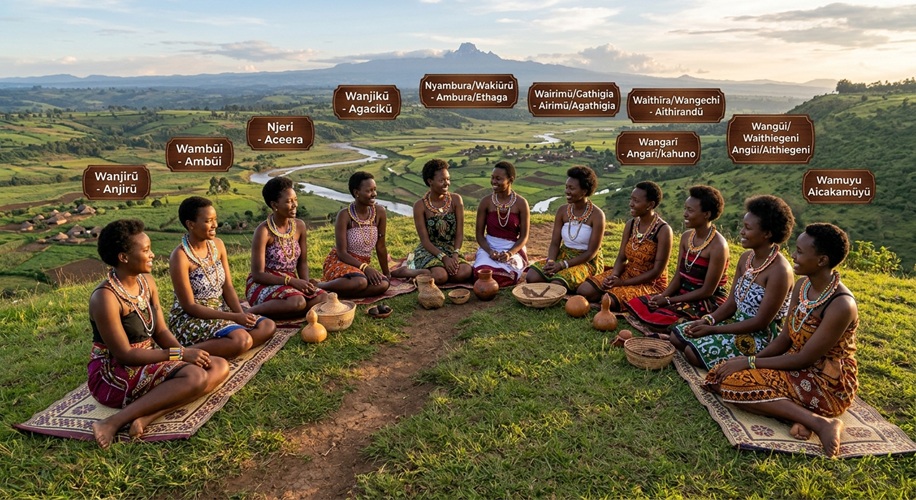
In precolonial Kikuyu society, identity was centered on 9 original matrilineal clans mĩhĩrĩga kenda, each named after a founding daughter of the ancestral pair, Gĩkũyũ and Mũũmbi.
In the course of years, mĩhĩrĩga have become divided into a vast number of sub-clans or mbarĩ. That’s why you’ll hear a Kikuyu describe families with “mbari ya”
The Agikuyu Tribe Origin
The names of the Adam and Eve of the Kikuyu version of creation are Gĩkũyũ and Mũũmbi. The word Gĩkũyũ means “The Big Fig Tree” and it is from this that the Kikuyu tribe derives its name. The woman’s name, Mũũmbi, means “The Creator”
The whole tribe descended from Gĩkũyũ and Mũũmbi who were set down by their Creator at a place called Mũkũrũwe wa Gathanga In Murang’a – the Kikuyu version of the “Garden of Eden”.
The 9 daughters each bore children, their children intermarried and the tribe gradually developed, with the children taking the names of their mother – the system being matrilineal and matrilocal.
Why Nine Clans, Yet Ten Daughters?
They are referred to as 9 clans despite being 10 because it was taboo to count people in their exact numbers. It is still taboo to do this today. This expression reflects a cultural tradition, that carry cultural significance beyond a numerical value. It’s commonly said “Ciana cititaragwo”
Some of the clan or the 9 daughters were in relation to animals, giants and the weather e.g:
- Wangarĩ – Child of the Leopard
- Wambũi – Daughter of the Zebra
- Wairimũ -Child of the Ogre
- Nyambura – Daughter of the Rain
While many clans shared general tribal rules, several possessed unique supernatural attributes, occupational roles, and even specific prohibitions.
For Instance, some clans were known for specific powers, gifts, or professional specialization.
Some of the clan attributes were
◍ Ambura were associated with the weather, and were believed to possess powers such as rain-makers that were depended on to bring or stop the rain.
◍ Ambura were mostly hired to perform various rites in the community and were great specialists in agricultural magic such as placing protective “mithaiga” on farms to deter thieves.
◍ Agacikũ clan was known to produce smiths and smelters and were traditionally prohibited from acting as circumcisors.
◍ Members of Ethaga clan were forbidden from working iron.
◍ Ethaga had supernatural hazard regarding the power of their gaze or words.
◍ It was believed that if a male member of the Ethaga clan admired someone, he could involuntarily bring evil or misfortune upon them and If such occurred, a medicine-man had to be called to counteract the effect by touching the victim’s temples, throat, and stomach with ritual mud made from spittle.
◍ The Ethaga clan was known as a lineage of diviners, rain‑makers, and ritual‑specialists.
◍ Ethaga played a key spiritual‑interpretive and healing role.
◍ Ethaga were feared for their “jinxed” image and rumored power to curse or control fortune, which made them both indispensable and cautiously treated within Kikuyu society – to date.
◍ Every clan had their own method of marking their goats and sheep, and the individual members of each main clan had their own minor variations of that brand.
◍ The Ambũi clan cut off a part of the left ear of their kids and lambs.
◍ Generally in Kikuyu society, people were forbidden from marrying a member of their own father’s or mother’s clan, as they were considered blood relations.
The List Of Kikuyu Clans
These nine daughters are regarded as the ancestors of the nine main Kikuyu clans, which are still named after them.
- Wanjirũ – forming the he Anjirũ
- Wambũi – forming the Ambũi,
- Njeri – forming the Aceera
- Wanjikũ,- forming the Agacikũ
- Nyambura or Wakῖũrũ – forming the Ambura or the Ethaga
- Wairimũ or Gathigia – forming the Airimũ or Agathigia
- Waithĩra or Wangechi – forming the Aithĩrandũ,
- Wangarĩ – forming the the Angarĩ or Aithe-kahuno
- Wangũi or Waithiegeni – forming the Angũi or Aithiegeni
- Wamuyu or Warigia – forming the Aicakamũyũ
The traditional Kikuyu clan system is a society whose identity extended beyond family ties. Through the mĩhĩrĩga kenda, our people understood their ancestry, marriage boundaries, social responsibilities, specialised occupations, and their place within the wider community.
As we study these customs today, we preserve more than the names of ancestral lineages. We preserve the stories, beliefs, and social principles through which earlier generations understood their world and passed their heritage to those who followed.
Drawing on historical works such as With a Pre-Historic People and Southern Kikuyu, we revisit these traditions, examine the knowledge recorded by earlier generations, and continue documenting the cultural heritage.
By understanding what our people practiced, why they practiced it, and what magic worked for them, we might recover valuable wisdom to help us live more naturally, make better decisions, and find solutions to some of the challenges we face today.