
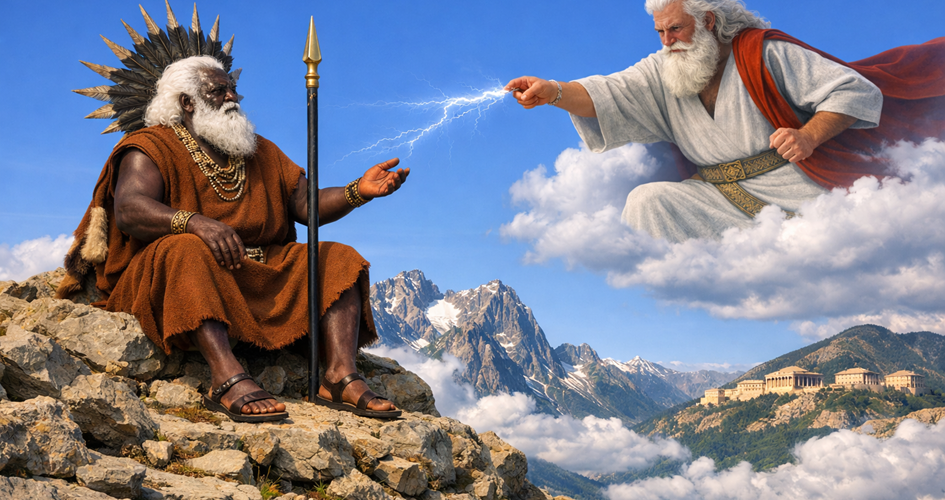
When missionaries and colonial adventurers arrived in Kikuyu country, they brought with them Yahweh the God of Israel wrapped in the authority of guns, schools, and churches. In the process, Ngai, the Kikuyu’s own high God who dwells at ‘Kirinyaga’, was displaced by the colonial narratives.
Ngai; The Kikuyu’s Sovereign God
Ngai was not, and is not, a minor tribal spirit but the supreme creator in our Kikuyu cosmology. He was originally worshipped through prayers, sacrifices, nature, and rituals performed under sacred trees or facing Mount Kenya.
Ngai embodied our Kikuyu identity, ethics, and connection to land and nature. His worship was communal, rooted in ancestral continuity, and never demanded exclusivity that denied the existence of other spirits.
Ngai was enough for the Kikuyu. We never went around crusading, trying to convert outsiders, or dragging people into his worship.
Meanwhile, the God of the Abrahamic religions comes with a whole violent history of expansion, forcing conversions and even killing those who refused, which is still happening to date.
Today, Ngai has been turned into an exclamation mark! Ngai! by His own people. Here, the exclamation that was used is Hai!
Who is Ngai in Kikuyu Cosmology
- Ngai is the supreme creator, dwelling at Kirinyaga (Mount Kenya).
- Ngai is central role in Kikuyu rituals: sacrifices, prayers, and ancestral mediation.
- Ngai is a unifying spiritual anchor for Kikuyu identity and ethics.
- Ngai is not a “lesser god” but the Kikuyu’s sovereign deity.
In the pre-colonial era, Kikuyu religion tied families together, united and bound inhabitants of every village and territorial unit together.
The Colonial Encounter and Manipulation
Missionaries introduced Christianity through schools, churches, and translations. This had the community change everything including their traditional clothing of leathers to the fabrics that came with the missionaries.
Figures like John Boyes – in his memoiur- dramatized his Christian god supposed superiority by firing guns at distant shields, convincing the Kikuyu natives of that era that his God was more powerful. This convinced the natives that their Ngai would not save them from this new god who had privided a gun that could cause such damage that fast.
Schools and churches became gateways to opportunity, but only if one accepted to drop their culture for Christianity.
At some point Kikuyu natives were made to choose between dying from disease or converting to Christianity to get medicine, which suggests that adopting Christianity was linked to survival under colonial rule, not necessarily spiritual conviction.
Christianity Was Political Triumph, Not Spiritual Supremacy
The rise and supremany of Christianity was tied to colonial institutions, and power politics not spiritual legitimacy or divine truths.
Theological exclusivity mirrored political control: one God, one ruler, one empire.
Erasing of culture and tribal customs is a definition of political conquest.
Rituals Alien to Kikuyu Practice
The adoption of Yahweh worship introduced rituals foreign to Kikuyu spirituality. Drinking blood and eating the “body of Christ” in Holy Communion were practices with no precedent in Kikuyu religion.
Traditional Kikuyu sacrifices involved goats or sheep, but never symbolic cannibalism. These rituals were imposed as markers of belonging to the new faith, forcing Kikuyu people to abandon their own sacred forms of worship.
Cultural Consequences
- Replacing Ngai with Christianity’s Yahweh severed Kikuyu ties to Mount Kenya as a sacred site, weakened indigenous rituals, and created generational disconnect from ancestral spirituality.
- While some Kikuyu Christians still pray to Ngai, syncretism – as in blending the two beliefs- its often discouraged by many denominations, with some publickly threatening to excommunicate members who attempt to engage in Kikuyu rituals.
- This dominance of Yahweh worship has now narrowed spiritual diversity and undermined Kikuyu cultural sovereignty.
- I have personally witnessed how political hostility surfaces whenever Kikuyu cultural interest groups gather to discuss heritage and attempt to revive traditional practices.
◼️These meetings are often disrupted, reported to authorities, and the participants quickly branded as ‘Mungiki’ – a label loaded with fear and terrorism.
◼️This tactic delegitimizes genuine cultural revival by equating it with militancy, effectively criminalizing Kikuyu identity itself.
This fear, always loaded like a gun whenever a section of Kikuyus attempt to revive their cultural practices, reveals the deeper truth that;
Christianity and it’s worship in Kenya were never purely spiritual movements. They functioned as instruments of politics and colonization, designed to suppress indigenous gods and delegitimize cultural sovereignty by branding cultural revivalists as threats.
David P. Sandgren in Christianity and the Kikuyu: Religious Divisions and Social Conflict (2000) :
Records oral testimonies showing that missionaries of the Africa Inland Mission (AIM) linked medical treatment and schooling to baptism and church loyalty. Families were forced to choose: convert to gain access to medicine and education, or remain outside and risk disease and exclusion.
Greet Kershaw – Mau Mau From Below (1997) :
Highlights how Kikuyu elders remembered being denied medicine unless they converted, reinforcing the idea that Christianity was a colonial tool rather than a spiritual conviction.
These two views from a non -kikuyu, proves that Christianity’s dominance was gotten and maintained not by faith alone, but by fear, force, and political control.
Today, reclaiming Ngai worship and other cultural practises is restoring Kikuyu cultural identity and recognizing that spiritual truth is not defined by conquest.