
Bank fraud and specifically digital conmen have become a very common issue and risk in Kenya, especially as more people today are using mobile/digital banking, debit card payments, and internet banking.
Every week, another Kenyan shares a story of losing money to fraudsters. From a fake bank call. Other times it’s a convincing SMS, a cloned ATM card, or a scammer pretending to be customer care.
Most of these scams can be avoided if you know what to look out for.
The key is to stay alert, verify everything, and never share banking information with anyone, not even those characters who call pretending to be bank representatives.
The banks have been clear on this: they would never ask for your PIN.
Common Fraud Tactics
Fraudsters, or “Kamiti guys”, and the famed “Mulot boys” mostly rely on your greed, urgency, or fear.
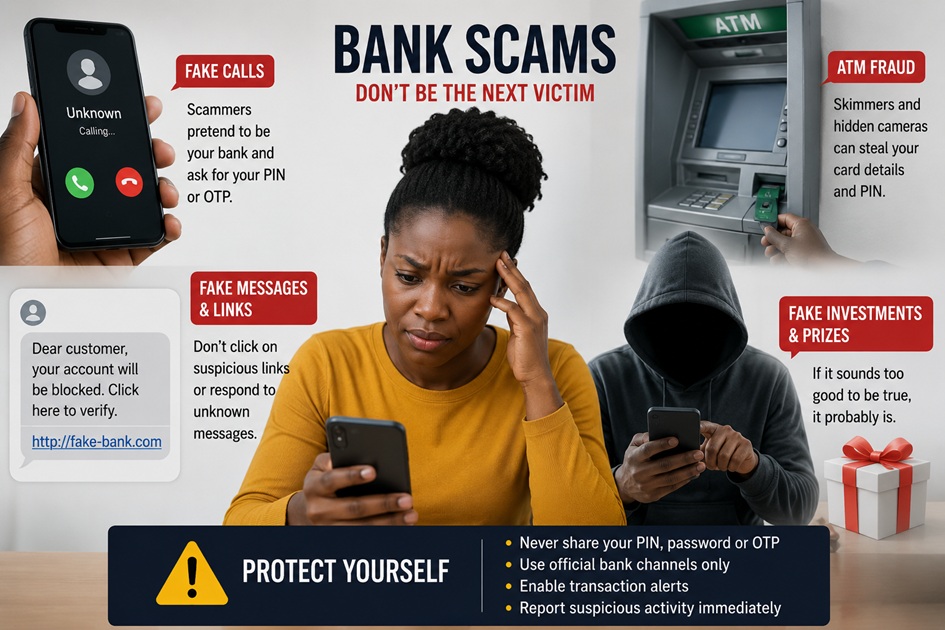
They will call pretending to be from your bank, send fake text messages with links, tell you you’ve won something, or ask you to “confirm” your PIN, password, or one-time code.
Other scammers use fake banking apps, ATM skimming devices, cloned bank websites, fake customer care numbers, and social media impersonation to steal banking information.
Safe Banking Habits:
One of the most important rules is simple:
- Your bank will never ask for your PIN, password, or one-time code through a call, text, or WhatsApp message.
- Always use your bank’s official app or website.
- Avoid clicking links sent through WhatsApp and Facebook messages.
- If you receive messages outside your app and official bank channels that you haven’t prompted, ignore them.
- Download banking apps only from the Google Play Store or Apple App Store.
- Check the web address carefully before entering your details.
- Use passwords consisting of numbers, symbols, and letters, to make them unique
- Enable notifications and turn on two-factor authentication.
- Avoid reusing passwords from email or social media.
While it’s not foolproof, these steps will make it harder for bank conmen to get you.
ATM and card safety
- Only use ATMs in secure places like those inside bank branches or well-monitored areas.
- Cover the keypad when entering your PIN, and check the card slot and surrounding area for anything unusual before using the machine, like the Nduthi gang waiting outside or galivanting around.
- Beware of your surroundings; note anyone who is following you or trying to bombard you with questions at the ATM
- If your card or phone is lost, report it immediately so the bank can block access before someone else uses it
- Avoid handing your card to strangers during payments or letting it disappear from your sight. Especially at the fuel station, no one should disappear with your card, even for 2 minutes.
- Have control of your card at all times.
Payment and transfer caution
- Before sending money, double-check the recipient’s name and number to avoid transferring funds to the wrong account.
- Be extra careful with “urgent” requests, prize and betting messages, or business deals that seem too good to be true, plus the “Nimekutumia pesa excess, toa nitumie kwa hii namba”
- When someone rushes you, especially a stranger, pause and verify first.
Remember that a legitimate transaction can usually survive a few minutes of confirmation. A scam often cannot.
Beware of SIM Swap Fraud
Fraudsters will try to replace your SIM card by pretending to be you. Once they control your phone number, they can receive OTPs and banking verification codes.
To protect yourself:
- Never share an OTP code {One time passwords}.
- If your phone suddenly loses network, especially during or after a call you’ve received from a stranger, contact your mobile provider immediately.
- Notify your bank and SIM provider if you suspect your SIM has been swapped to freeze it.
- Check with your network to see who else has registered a SIM with your ID.
QR Code Scams
Be cautious when scanning QR codes in public places or those sent through WhatsApp and Facebook DMs. Fraudsters do replace legitimate QR codes with fake ones that redirect you to their phishing websites.
Cables
Don’t use public USBs at the public charging points. USB ports can be used to target your bank accounts through a cyberattack known as “juice jacking.”
Since standard USB connections are built to transfer both power and data simultaneously, these cables can be used to secretly install data-stealing malware onto your device the moment you plug it in. Nunua Power Bank.
Public WIFI
Public WiFI, or any WiFi without a password, allows attackers to intercept network traffic, set up trap networks, or redirect users to lookalike or clone banking websites.
These Wi-Fi networks are also used to install Malware/Virus that capture your banking data.
Turn off the feature that lets your phone automatically join nearby open networks from your Wi-Fi settings.
What To Do If You Suspect Fraud
- Stop communicating by hanging up.
- Contact your bank via official call centres and ask them to block the card, account, or the transaction.
- Change your passwords and email immediately
- Stay online in your account to watch for any unusual movement in your account.
The faster you act, the better for you. Fraudsters in Kenya rely on delay, so quick reporting matters.
It is always better to be cautious than to explain your loss on Facebook and TikTok later while blaming your bank.
Golden Rules for Safety:
✅ Never share your PIN or OTP.
✅ Never let anyone pressure you into sending money.
✅ Verify suspicious calls using your bank’s official number.
✅ Ignore messages claiming you’ve won money.
✅ Ignore messages claiming you’ve been sent money by mistake.
✅ Keep your banking app updated.
✅ Enable transaction alerts.
✅ Don’t use the same passwords and emails you use for social media.
Final Thoughts
Staying safe from bank fraud in Kenya is mostly about being very alert and careful. It’s not once or twice that we’ve heard people’s bank accounts being swept clean.
Stay vigilant, verify requests, protect your PIN and passwords, use only official banking channels, and treat any urgency you’re coerced into as a warning sign.
With these precautions, you can reduce your risk and keep your money safer in a country where scammers are always looking for a chance to swindle you.