
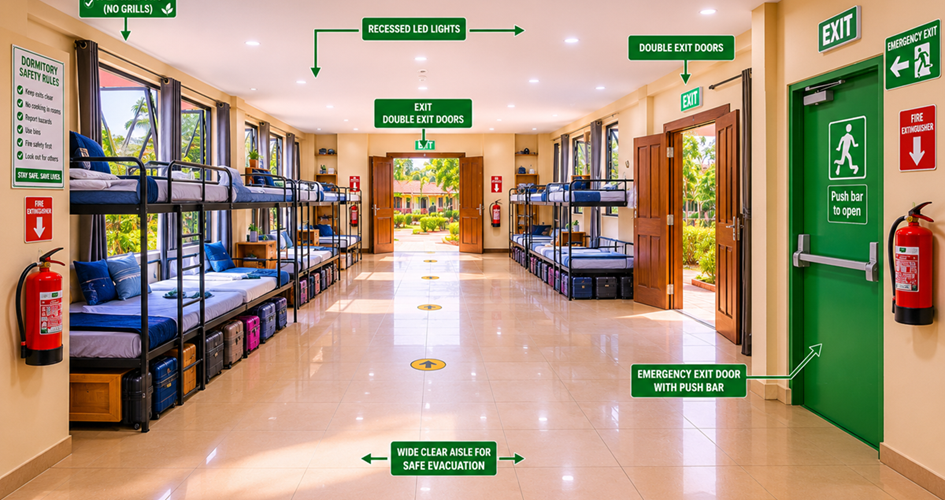
All learners in Kenya deserve to have a safe and secure learning and boarding environment. Safety standards for boarding schools in Kenya have been in place for several years; it’s just that schools are rarely assessed or prosecuted for failure to comply.
In Sheria za Kenya, all institutions must adhere to the Ministry of Education Safety Standard Manual and have all buildings approved by Public Health and Quality Assurance officers. Is yours approved?
At Kiispace, we mourn with the families who have lost their children at Utumishi School.
As a parent myself, it is time we remind ourselves of the safety standards set by the Ministry and ensure the schools we send our kids to meet these standards.
Safety measures are upheld not only by the Ministry, principals, and school directors but also by staff, learners, and parents.
We must all be involved in minimizing or eliminating any risk or threats that cause accidents in schools. Because these accidents have caused loss of life, disability, and psychological trauma to children in this country, it’s time to have a checklist.
Dormitory Safety Compliance Checklist
These are the compliance standards set by the Ministry of Education.
- Doors and windows must open outwards.
- Doors and windows should never be locked from the outside when students are inside.
- Window grills are strictly prohibited to allow for easy exit during emergencies.
- The minimum space between beds must be at least 1.0 to 1.2 metres.
- The corridor or pathway in dorm space should be at least 2 meters wide.
- Beds must be single or double-deckers.
- Sharing of beds is prohibited.
- Bunk beds or the deckers must be fitted with side-grills to prevent students from falling.
- Each dormitory must have a door at each end and a clearly labelled “Emergency Exit” in the middle.
- Every dormitory must have functioning fire extinguishers placed at each exit and fire alarms fitted at easily accessible points.
- Wide stairways must be located at both ends of the building.
All dormitory designs must be approved by the Ministry of Public Works, the Ministry of Education, and the Department of Public Health before construction or occupation. If you spot ongoing construction without required signage, report it to the MoE.
Sanitary Requirements
- Pit latrines should be at least 6 metres deep, and regularly disinfected.
- Pit latrines should be located at least 15 metres away from water sources and 10 metres away from boarding facilities.
- Adequate washing and toilet facilities should be located adjacent to the dormitory.
- Soap and water, taps or water cans, must be placed outside toilets for handwashing.
Security Requirements
- Schools are required to have properly reinforced fences.
- Schools should have lockable gates with both day and night security personnel.
- Schools must have a reliable system for accounting for every learner at all times.
- All criminal activities by learners must be reported to the police for action, and learners must be informed that such records will affect their future.
- Due to the risk of arson, the principals must reinforce vigilance in dormitory areas by having teachers on duty patrol the dorms when learners aren’t around.
- Schools should be located away from disruptions like bars, industrial facilities, and heavy traffic routes.
- Principals of boarding schools are expected to reside within the school to oversee security and management.
Classroom Requirements:
- A classroom should accommodate a maximum of 30 learners with one-seater desks or 40 with two-seater desks.
- Classroom doors must open outwards and should be designed as double doors.
- Classroom doors must never be locked from the outside while learners are inside.
- Classroom windows must not have grills or burglar-proofing.
- If the classrooms are in a multi-storey building, there must be wide stairways at both ends of the building.
- Corridors should be wide enough for learners to walk without bumping into one another
There is a 2020 case where a deadly stampede occurred at Kakamega Primary School in western Kenya, killing 15 students and injuring tens of others.
After the investigations, a Kakamega court ruled that the school management and the Ministry of Education were 100% liable for failing to ensure learners’ safety. In 2023, the court awarded 1.25 million shillings to each of the 15 victims’ families.
Institutional and Community Security
- Any criminal activity by learners must be reported to the police, and schools should alert security agencies regarding any possible causes of unrest to prevent damage and injuries.
- School administrations must be vigilant to curtail the entry of drugs and alcohol into the institution.
- Schools are expected to work closely with the Ministry of Interior to ensure overall institutional security.
The last time a real assessment of boarding primary and junior schools was done was after the tragic fire at Hill Side Endarasha Academy on September 5, 2024, which resulted in the death of 21 students.
We cannot wait for such sad events to act.
As parents, it must start with us.
- If the school doesn’t allow you to view the sleeping conditions, simply look elsewhere.
- If school directors and owners do not listen to parents’ input, complaints, and criticism, we should move on to schools that listen.
We should not allow schools to put us in a position where we feel trapped while children’s lives are put at risk. Life does not stop at one school, and there are always other options available.
Please let me know your thoughts!