
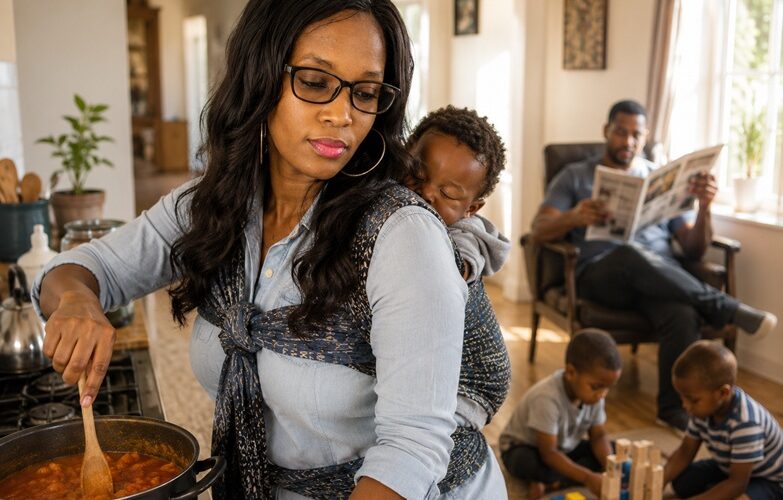
A man may call himself modern and support equality and women’s education; and still expect his woman to cook, clean, do homework with the kids, and sign off school diaries AFTER 6pm when she arrives from her stressful office employment.
So why does patriarchy still pressure women into the “kitchen” in 2026?
Why do we continue to treat family duties as a woman’s default role while we protect a man’s work, income, and goals?
Yet, when a woman doesn’t have a career and wants to be a “stay-at-home” wife, she is labeled as lazy, lacking ambition, stupid, a gold digger and a social climber.
This pressure is coming from millennial partners – who should be too woke for that mindset – friends and, of course, social media.
It doesn’t always sound openly hateful or emotionally blackmailing.
It presents itself as “traditional values”. Expressing concerns about children, asserting that women are better suited to stay at home.
But this issue is larger than who makes supper after their 8 to 5, who iron’s work clothes, while the other has their feet on the table.
It is about who gives up money, freedom, time, and future choices so the other person can keep moving forward.
Personal Choice Is Different From Gender-Based Entitlement
A couple may discuss and decide that one partner will stay home. That choice can be healthy when both people agree, understand the financial effects, and have room to change their minds.
The problem begins when a man assumes a woman should cook, clean, or quit work because she is female and her work is NOT important.
Saying “a woman’s place is in the kitchen” turns a social rule into a supposed fact of nature. It removes a woman’s right to choose.
Younger Men Have Inherited The Old Ideas
Gen Z and millennials were raised with conflicting messages.
They witnessed more women getting an education and pursuing careers, but many also observed fathers concentrating on their jobs while mothers took care of every household chore alone, while the man read his newspaper.
Children learn through their family habits, movies, churches, schools, friends, and online culture.
A man may reject the word “patriarchy” while still believing that his good woman should directly serve the family – cook fresh meals every day, “juu mzee hakulangi food ya fridge” 🤣- and he should just provide, aka pay rent. While the woman still contributes 50% and buys food and clothing.

This is not bad per se. The problem arises when the man uses this chance to abuse emotionally, financially, and mentally.
How Patriarchy Makes Women’s Careers Seem Disposable
- Many couples treat the man’s career as a fixed point and the woman’s career as flexible. This is happening even when both partners have similar education, pay, and professional goals.
- The family will relocate for the husband’s job, while the woman’s job is seen as an easier one to pause or quit.
The decision may sound practical, but it rests on an old belief that men’s work matters more.
- Leaving work even for two years nowadays means lost wages, missed promotions, weaker professional ties, and lower retirement savings.
- Returning to a career may also bring lower pay or fewer choices, especially after years away.
- Returning to employment gets harder as one gets older.
Men Heavily Rely On Unpaid Labor
A husband’s uninterrupted career fully depends on a woman’s interrupted life. From managing meals, laundry, school forms, doctor visits, childcare, to managing ALL family plans.
These chores have economic value even when no paycheck records them.
Yet, a man will have the audacity to ask a woman – with 2 toddlers – what she was doing all day at home.
A man cannot call this housework worthless or “simple” while depending on it every day for his own freedom.
And this is where we see contradictions; everyone says,
- A woman should have an education.
- A woman should have a job.
- A woman must depend on her own money.
But somehow, when they come back home in the evening tired, they are expected to cook, clean, care, supervise homework, and be a general household manager. This expectation persists despite their own long and stressful days in the office.
That is not equality.
That is expecting women to have modern opportunities while carrying traditional responsibilities.
No woman belongs in the kitchen because of her gender.
And no man’s career deserves protection at the cost of a woman’s future and safety